



Agile Project Management for Data-Driven Organizations
Nowadays most of the companies are focused on developing and implementing new enterprise strategies, in order to come up with the new challenges that appear in the global market. Despite their efforts and investment of time and money, they still struggle to demonstrate the business value gained from these efforts. This investment without measurable return pushed them to pivot their strategies to use data to drive the company growth. Hence, they started adopting new data strategies and leveraged new technologies such as Machine Learning (ML) and Artificial Intelligence (AI), in order to introduce new concepts inside their businesses such as data platforms, data products, etc., which will allow them to alleviate complex data problems and provide their business with scalable and flexible capabilities.
However, in order to disrupt previous approaches and transform their organization into a data-driven one, an internal product-driven culture needs to be developed, where data and analytics are properly exploited to address stakeholder demands, learn from feedback, and efficiently prioritize business value. By applying the concepts of Agile project and product management to data, they are now capable to achieve these goals, simplifying the complexity of the current technology landscape and providing the agility to meet the needs of the business, while also producing measurable results and promoting an enterprise-wide product cultural alignment.
The total learning hours for this Module amount to 100. These are distributed across the following categories:
- Total Contact Hours: 20
- Self-Study Hours: 20
- Supervised Placement and Practice Hours: 10
- Assessment Hours: 50
This Module carries a value of 4 ECTS.
What you'll learn
Module-Specific Learner Skills:
At the end of the module/unit the learner will be able to
Identify social and ethical responsibilities associated with knowledge.
Solve problems analytically and strategically.
Integrate theory, research findings and practice for real-world problem solving.
Connect with relevant audiences with effective and strategic business forms of communication.
- What is Agile Methodology and what is it its Key principles
- What is OKRs and why to use them
- What are the most important Agile frameworks and how they could be applied in real projects
- What Management models exist that rely on Agile Methodology
Competences:
At the end of the module/unit the learner will have acquired the responsibility and autonomy to:
Manages people and projects and demonstrates the ability to respond to the fast-changing business environment.
- Take responsibility for agile project management methodologies.
- Demonstrate accountability for effective project planning.
Demonstrates autonomy in the direction of learning and a high level of understanding of learning processes.
- Make data-driven decisions autonomously.
Knowledge:
At the end of the module/unit the learner will have been exposed to the following:
Integrate forward-thinking concepts, standards, and managerial decision-making tools in the functional areas of management.
- Illustrate Agile Methodology and what its key principles are.
- Critically analyze management models based on Agile Methodology.
- Designate and synthesize
- Critically evaluate the concept of a data-driven organization and analyze its significance in modern business environments.
- Assess the steps required to implement a data strategy within an organization and synthesize best practices for successful execution.
- Analyze the principles of Agile project and product management and evaluate their application to data initiatives.
- Discuss the importance of properly exploiting data and analytics to address stakeholder demands.
- Explain how learning from feedback can help prioritise business value.
Skills:
At the end of the module/unit the learner will have acquired the following skills:
- Agile project management methodologies
- Enhance decision-making skills in data-driven enviroments.
- Collaborate effectively within teams and manage team dynamics in agile environments.
- Connect with relevant audiences within data-driven enviroments with effective communication startegies.
- Project planning and execution in dynamic, agile settings.
- Communicating and negotiating across departments (e.g., data science, IT, marketing, and operations) to align business objectives with data strategies.
- Ability to lead and influence cross-functional teams or stakeholders without direct hierarchical power.
Learning Procedures
Module 1
Business Transformation based on Agile Methodology
- What does agility mean
- Agile principles
- Interventions that accelerate the IT transformation
- Key principles that enable agile business operations
- Changes to employee journey
Module 2
Objectives and Key Results (OKR)
- What is OKRs and why to use them
- Main characteristics of OKRs
- Objective, Key Results and deliverables
- Assessment framework for data-driven organizations
- Requirements process
- Principles of Agile Architecture and Data Governance
- A sample roadmap for a data-driven organization
Module 3
Scrum, Kanban and SAFe Frameworks
- Scrum framework
- Kanban framework
- SAFe framework
- Program, Kanban and Scrum events
- Scaling based on Scrum of Scrums
- From program to team level with OKRs
- Items hierarchy and relation to OKRs
Module 4
Applying Agile Framework
- A Lean Scrumban process to empower business operations
- How to get started
- Actions overview
- Timeline
- Team vision and agreements
- DOR, DOD and AC
- Create readiness with Backlog refinement
- Track progress
Module 5
Agile Business Management
- Capability Model Management
- Backlog management
- Service Level Management
- IT Risk Issue Management
- Design and programming
- Continuous testing
- IT Service Continuity Management
- Release and deployment management
The digital learning tools that are being used during the programme are the following:
- Learning Management System (LMS).
- Real-time lectures that are recorded.
- Zoom platform.
- Power Point for Creating - Presenting Learning Materials.
- Interactive Case Studies.
Assessment Procedures
| Assessment Type | Weight |
| Group Assignment 1 | 50% |
| Group Assignment 2 | 50% |
| Total | 100% |
Passing grade 60%
Instructors
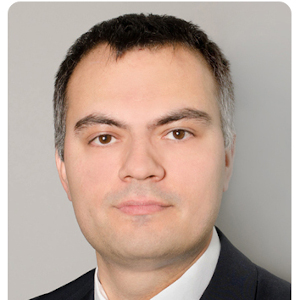
Dr. Georgios-T. Michailidis
Enterprise Architect Mercedes-Benz Group AG, Enterpreneur, Founder, Business Consultant